
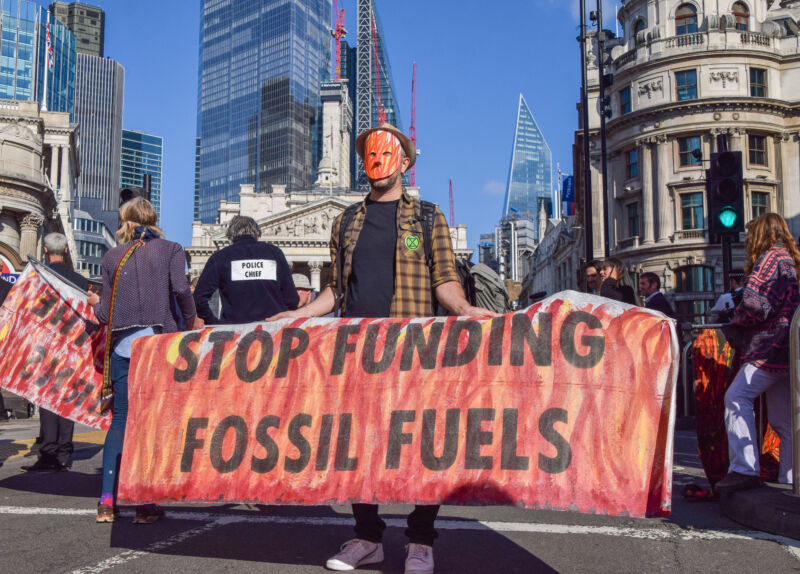
 enlarge / A protester wearing a mask holds an anti-fossil fuels banner right through the demonstration outdoor the bank of England. Vuk Valcic/SOPA pictures/LightRocket by means of Getty photos reader feedback 17 with Share this story
 this article at the beginning seemed on inner local weather news, a nonprofit, unbiased news organization that covers climate, power, and the atmosphere. it is republished with permission. sign up for his or her newsletter here.
If funds makes the world go circular, it's going to be no shock that fossil gas nevertheless powers the global economic system. Ever due to the fact that world leaders reached the Paris local weather contract in 2015 to restrict warming and slash the toxins using it, environmental groups have chronicled the endured movement of finance from the wealthiest banks to the oil and gasoline trade.
local weather advocates had been expanding the pressure on banks to alternate direction, and a lot of lenders have answered via adopting guidelines to cut back the climate toxins generated through their vast portfolios. Some have additionally pledged to stop financing definite styles of fossil fuel extraction altogether, such as coal mining and Arctic drilling. but have those guidelines made any change?
A pair of new studies provides a muddled graphic. Banks lent greatly less cash to fossil gas corporations final yr, in line with a record through a collection of environmental groups led by Rainforest action community. despite the fact, the decline changed into possible driven not with the aid of selections the banks made, the record observed, however because oil businesses were sitting on so a lot cash they didn't should borrow any. Many oil establishments, including ExxonMobil and Chevron, earned checklist gains ultimate year.
All informed, the area's suitable 60 banks plowed $673 billion in financing into fossil gasoline businesses closing year, according to the report, which is the bottom quantity when you consider that the companies began tracking in 2016. regardless of the decline, the file's authors spoke of the banks' fossil lending policies stay susceptible and insufficient, and that such financing isn't declining essentially fast sufficient to curb local weather toxins in accordance with the Paris agreement's more formidable goal of limiting warming to 1.5° Celsius, or 2.7° Fahrenheit.
"We nonetheless see just this huge move of finance into fossil fuel organizations, including into corporations which are increasing fossil fuels," mentioned April Merleaux, analysis supervisor at Rainforest action network and the report's lead creator. The file singled out the largest corporations concerned in fossil gas growth—these exploring new oil fields, as an instance, or building new pipelines—and located that banks had lent them $150 billion ultimate yr. "each dollar that's going into enlargement is a dollar that's pushing us previous that 1.5-degree goal."
commercialIn 2021, the overseas energy company talked about that no new oil and gas fields should still be developed if the area is to fulfill that goal of the Paris settlement.
A second report analyzed the fossil fuel lending policies of the correct six American banks and in a similar fashion discovered them to fall wanting assembly the Paris contract desires. That document become posted by the sustainable investment nonprofit Ceres and the Transition Pathways Initiative middle, a low-carbon research institute primarily based on the London faculty of Economics and Political Science.
The studies come amid multiplied scrutiny of the function of financial markets in reducing emissions across the economic system. local weather advocates have taken to the streets to induce banks to phase out fossil gas lending, and the Biden administration has adopted new rules to raise climate disclosures in financial reporting. in the meantime, Republicans were pushing again, with some states enacting legal guidelines supposed to punish banks that prevent lending.
Pavel Molchanov, an analyst with the financial enterprise Raymond James, agreed that the decline in lending remaining 12 months become pushed largely by the undeniable fact that many oil groups earned greater funds than ever. however new drive from traders is beginning to have an impact on how oil corporations spend their cash, too, he introduced. an awful lot of that force is from typical traders looking for better returns and greater disciplined spending from the industry, as opposed to lessen emissions. The outcomes is an identical, he pointed out, "which is drill less."
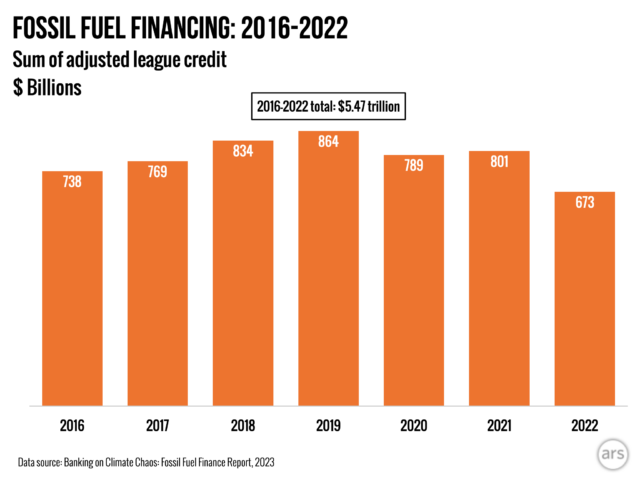 magnify / a brand new record indicates that fossil gas lending by the world's 60 largest banks fell final 12 months, even though the decline became possible pushed at the least partly by means of list oil gains.
  amplify
 In a note this week, Molchanov and colleagues wrote that besides the fact that children capital spending with the aid of oil organizations climbed final 12 months, it became still slightly beneath pre-COVID-19 pandemic levels and far reduce than a decade ago.
"These corporations had been swimming in profits," Molchanov mentioned, "but they're not spending practically as a lot as they used to. What do they deserve to borrow? It's just no longer vital."
based on the Rainforest motion community file, at least seven major oil companies, together with ExxonMobil and Shell, asked for zero in financing ultimate yr after having borrowed, on commonplace, greater than $50 billion annually over the old six years.
Steven Rothstein, managing director of Ceres' Accelerator for Sustainable Capital Markets, mentioned banks have begun transferring more funds from oil and fuel to clear energy, "however no longer sufficient. they are still financing too tons, and not simply fossil fuels," he introduced. "It's also the industries that use fossil fuels."
The Ceres document compared the fossil lending guidelines of the six greatest American banks—four of which additionally occur to be the largest lenders to the fossil gas sector over the last seven years—and located that none of them are aligned with the goal of limiting warming to 1.5°. just one, financial institution of america, has a policy aligned with limiting warming to less than 2° Celsius, the much less bold aim of the Paris settlement and a degree of warming that might convey more unhealthy affects from extreme weather and better sea level upward push.
Rothstein pointed out the Biden administration's target of reducing climate toxins 50 p.c under 2005 degrees through 2030 will stay out of reach unless banks movement quicker.
"We're no longer going to get there as a society if the banks continue to finance new fossil gas areas," he referred to.
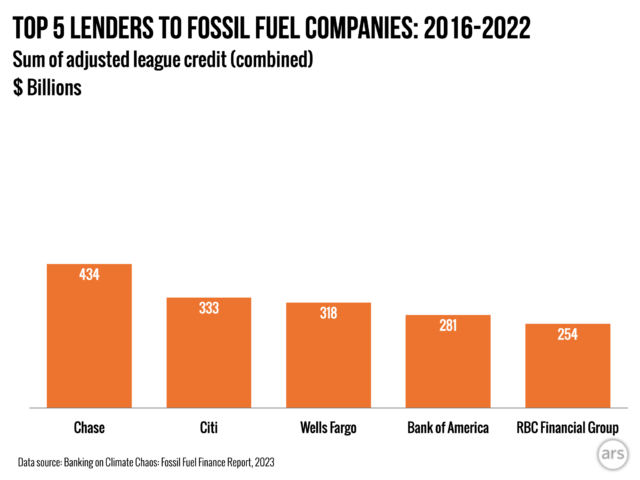
JPMorgan Chase has offered essentially the most by a ways to fossil gasoline corporations given that 2016, more than $434 billion, in accordance with Rainforest motion network, adopted through Citi, Wells Fargo, and bank of the united states. The different two banks profiled through the Ceres document, Morgan Stanley and Goldman Sachs, lent extensively less.
The Rainforest action network record also assessed the lending policies of the banks, and each shared some critiques, equivalent to finding an over-reliance on carbon offsets to meet objectives.
Charlotte Powell, a Chase spokesperson, pointed out her business's growth in reducing financing to oil and gasoline "may also not be linear," and that Chase had "facilitated more than $one hundred seventy five billion for eco-friendly actions like renewable energy, energy effectivity and sustainable transportation" in 2021 and 2022. She spoke of that placed the financial institution on its strategy to a aim of $1 trillion for eco-friendly initiatives via 2030, and that "we are additionally taking pragmatic steps to satisfy our 2030 emission intensity reduction ambitions within the six sectors that account for almost all of international emissions, whereas assisting the world meet its power needs securely and cheaply."
advertisementThe Rainforest motion network document pointed out that forty nine banks with guidelines to reach web-zero emissions from their portfolios with the aid of 2050 had lent $122 billion last yr to companies engaged in fossil fuel enlargement.
Some banks have adopted limits on lending to oil and gas drilling in the Arctic or to mining in Canada's tar sands, but these policies have done little, the document said. Many Arctic policies avert lending to specific tasks, as an example, but don't curtail ordinary corporate lending to groups that might take place to be drilling within the Arctic. assignment-selected financing made up only four % of all lending on standard in contemporary years, based on Rainforest motion community, and a few banks with Arctic policies continued to lend to ConocoPhillips, which is poised to embark on an immense drilling venture in Alaska's Arctic.
"In some ways they appear to be greenwash," Merleaux referred to of the banks' guidelines.
Emily Chasan, a spokesperson for Citi, pointed out the bank's 2030 emissions pursuits for energy financing were according to modeling by the international power agency for achieving web-zero emissions by using mid-century. "we're working with our purchasers on their transitions and aiding clear energy options to aid meet the world's future power demand with clear, low-carbon sources, whereas additionally continuing to fulfill today's international energy wants," she observed.
bank of the united states, Morgan Stanley and Wells Fargo declined to comment.
Goldman Sachs did not reply to requests for remark.
The focus on banks' guidelines assumes that their lending has the energy to form markets. That may sound intuitive, however some have pushed returned on the thought that cutting off lending from essential banks would be an exceptional lever for climate action.
"there is a lot of cash out there attempting to find returns. the realm isn't short on capital," mentioned Samantha Gross, director of the power safety and climate initiative on the Brookings establishment. If predominant banks cut off finance to grease corporations, Gross mentioned drillers would possible find funds in different places. European and U.S. banks have sharply cut lower back lending to coal, in line with the Rainforest action network record. but chinese banks have persevered, and coal use hit a list excessive remaining yr.
advertisementAnd if banks did reduce their lending to oil and gasoline, Gross argued, and oil businesses were pressured to reduce components of fossil fuels quicker than americans had been cutting back their consumption, that could lead on to rate shocks that might hit poorer people tougher.
as an instance, Gross pointed to the fallout of Russia's cutting off its gas give to Europe final 12 months and the resulting embargoes on Russian oil and fuel, all of which sent energy fees soaring.
"everybody talks in regards to the success story of Europe getting via this iciness," Gross observed, "however what receives less stated is this happened on the fee of the constructing world."
Pakistan, for example, confronted fuel shortages and reacted by using saying a plan to enhance coal consumption sooner or later.
Merleaux rejected the thought that banks shouldn't avoid financing, arguing they have an capacity to help set the pace and route of a transition off of fossil fuels.
"Our belief is that banks in fact do play a crucial position in making these changes in the economic climate," Merleaux noted. They make chance calculations with wide social penalties, she added, and "here's a case the place they don't seem to be evaluating the long run local weather risks with as a whole lot seriousness as they deserve."



0 Comments